
MODERN DELIGHTS 2
33

Ah yes. Now for a bit post. A list-of-stuff post. One of those posts that makes me feel as if this account has lost its meaning. I am an aging variety show host, jabbering away relevance, softening like focus, along with all a generation as we approach the gardens of memento mori. Possibly, my idylls occasioned with pleads for tithing back when I started this thing, wove in a subconscious personal expectation—that I’d create a soaring blog, a blog much more than twiddling personal minutiae. Or maybe because my first written post was about scrolling through an active genocide like Ebay window shopping (a theme I would return to again), because I shared my thoughts on the role of that activity in modern globalization (and again), I induced the narcissus of some hypnagogic Sibyl-sense. I asked of you, my dear readers, “Do I not know this world? Do I not course its veins, electrify its synapes all??” Ah well. Whatever it was. My writing has been useless to cease the militarized slaughter of people shivering in hovels anywhere, and my art routinely fails to secure the kola nuts necessary to disappear myself to a secret cave of wonder; so instead I am here, still, wizarding up sad little fillers and updates. This time: a furious jotting of a few months worth of the things I’ve been into, painstakingly overwrought to seem like there’s possibly substance here apart from me just talking about myself in a quirky little writing exercise. I sure hope you get something nice out of it though. Let’s get going.

DISCORDIA REVIEW

What do you know. A week or two ago a little poem and a couple of photos by yours truly surfaced on Discordia Review’s Fellow Travelers page. I like Discordia a good bit. I know this because I actively spent time and mental energy trying to come up with reasons not to like Discordia at all. You see, Discordia Review is a site, or a blog, or a collection of social media profiles, orchestrated by a group of apparent Canadians, here on Substack, revolving around literary and cultural criticism from the vantage of the political left. Well guess what? I too hang my coat on the political left, and I too opine scathingly on the state of literature, culture, literary culture, all that shit. And since *we all know* that the duty of a good leftist is to apply a rigorous and crippling appraisal to the projects of any other good leftist, I was obligated to try summoning as much contempt for them as I could for no discernable reason other than that we cannot possibly allow ourselves a win. As it turns out though, the only real gripe1 I’ve got against Discordia is that I have to be online, on social media, to consume their work, and unfortunately being online, on social media, has become very annoying to me of late. I suppose that this is because the majority of web perched punditry is obsessed with crafting short-form, repostable snivelings, bleating about how bad things are in the pursuit of easy engagement; clearly a functional tactic if you’re looking the numbers, but holy shit is it fucking tedious to sift through. Sure, there may be a lot of people out there who agree: The flaccid productions dribbled out by modern MFA grads do indeed tend toward impotence. And indeed: The blue chip art complex is a bland cover for wealth crimes and lobbyism. You know what though? By endlessly bitching and bitching and bitching about this shit it not only gives more energy to *the shit* itself, but it is also deeply, sadly, fucking corny. Anything but that! Did Homeland Security kick down your door and rip you from your loving family, force you to attend the Iowa Writer’s Workshop and waterboard you until you agreed with the Pulitzer committee’s take on Bob Dylan? No?? Then RELAX. I’m a hater too, but seriously, get a life! Sure, a good salvo is necessary from time to time, but those are meant to be conversation starters—dialogues—not lectures, and certainly not the “What if Cioran was obsessed with hating NYRB and had Twitter” fantasy that that a lot of culture bloggers seem to be striving for. Anywho, before I spiral out completely and start doxing accounts, I should say that none of this is Discordia’s fault. To soapbox you need to go where the people are, and everyone’s hanging like a noose online nowadays. They criticize (scathingly for that matter), sure, but I don’t get the impression of delusion. They invite engagement; even highlight it. Additionally, for professed malcontents, they actually do seem to like things. The Fellow Travelers series, which strives to illuminate new and exciting work is very regular! They also seem to understand that we are living in a golden age of being able to find really interesting stuff really easily. Examples: The Iron Dream. Zero Kama. A bunch of folkies I’d mostly not heard of but will probably get around to checking out. In fact, Discordia is consistently active enough, and grabs my attention enough, to admit that I should probably pay for my subscription to them by now. You should too. Maybe if we all give them enough money they’ll clear a hurdle to regular ol’ print distribution. Imagine! We all opt out of these hideous social media platforms and revel. A delightful cavalcade of Discordia staff’s best polemics and diatribes arriving, paper bound in glue, direct from the post… quarterly? Monthly? Oh my God, are we going to invent magazine subscriptions? Hey. This got weirdly long. I think Discordia is fun to read and I’m happy to be included in their oeuvre this year.
Pictured above, a photograph I submitted that they did not accept.
NAPA STATE HOSPITAL by Patricia Prestinary
I tell you what. I really am working on a the longer form thing I have mentioned in a couple of other posts—in part, a story, sort of, though it doesn’t tell much of a story on its surface—which I intend to be part of a larger writing collection. I began arranging the bones of this project on the windowsill of some almost-downtime last summer, shortly after I’d realized that between some unavoidable auto repairs and the expenses required of me for a destination wedding I’d been obliged to attend, that there was absolutely no fucking way I’d finish the other longer form thing I had already been working on by the end of the year. That thing being a project requiring, you guessed it, ca$hola. C’est la vie. I’m happy pussyfooting the details and being opaque on my creative tinkering, but I still feel the need to convince you that tinkering I have been, so I do have this to share: in the recent act of fact checking a short paragraph I’d written for the aforementioned project (the first aforementioned project), I found my broke ass summoned to the local library to read up on Napa State Hospital. It’s making an appearance in some work and I like to have shit straight in my mind when I’m writing about real places and people, even if I ultimately decide it’s more entertaining to lie on the page. Unfortunately printed material on the asylum is in a dearth. The only physical book I could find specifically dedicated to it was Patricia Prestinary’s eponymous title from Arcadia Publishing’s Images of America series, a series that quite frankly I’ve never given much credence to, due to the fact that they appear specifically designed for middle school children to plagiarize for a passing grade on their local history report. However! Not only did the book answer my question, but it new questions that I hadn’t actually asked and answered those as well. And in doing this it sparked a whole circuit of exciting curiosities within me. Teach me to be judgmental why don’t ya? I’ve been passing evenings lately with further reading on The Napa County Historical Society site, digesting the work of amateur YouTube historians, podcast kooks milling about the area, and so forth. I could go on, but if you’re here in the first place I doubt you need my endorsement on the importance of archival work, indexing, or library systems. Suffice to say that this has been a fun topic for me to obsess over, and long overdue since I grew up so close to the place. Anyway, check out this one excerpt from Prestinary’s book that gripped me:
The Asylum Appeal was written and printed by John Donovan, a patient. It provided “more reading matter for the patients than ever before known.” The newsletter included poetry, letters from patients to the editor, articles of goings-on of the asylum, various observances and jokes, weather reports, and local advertisements. Donovan reportedly disappeared into the hills and returned some months after.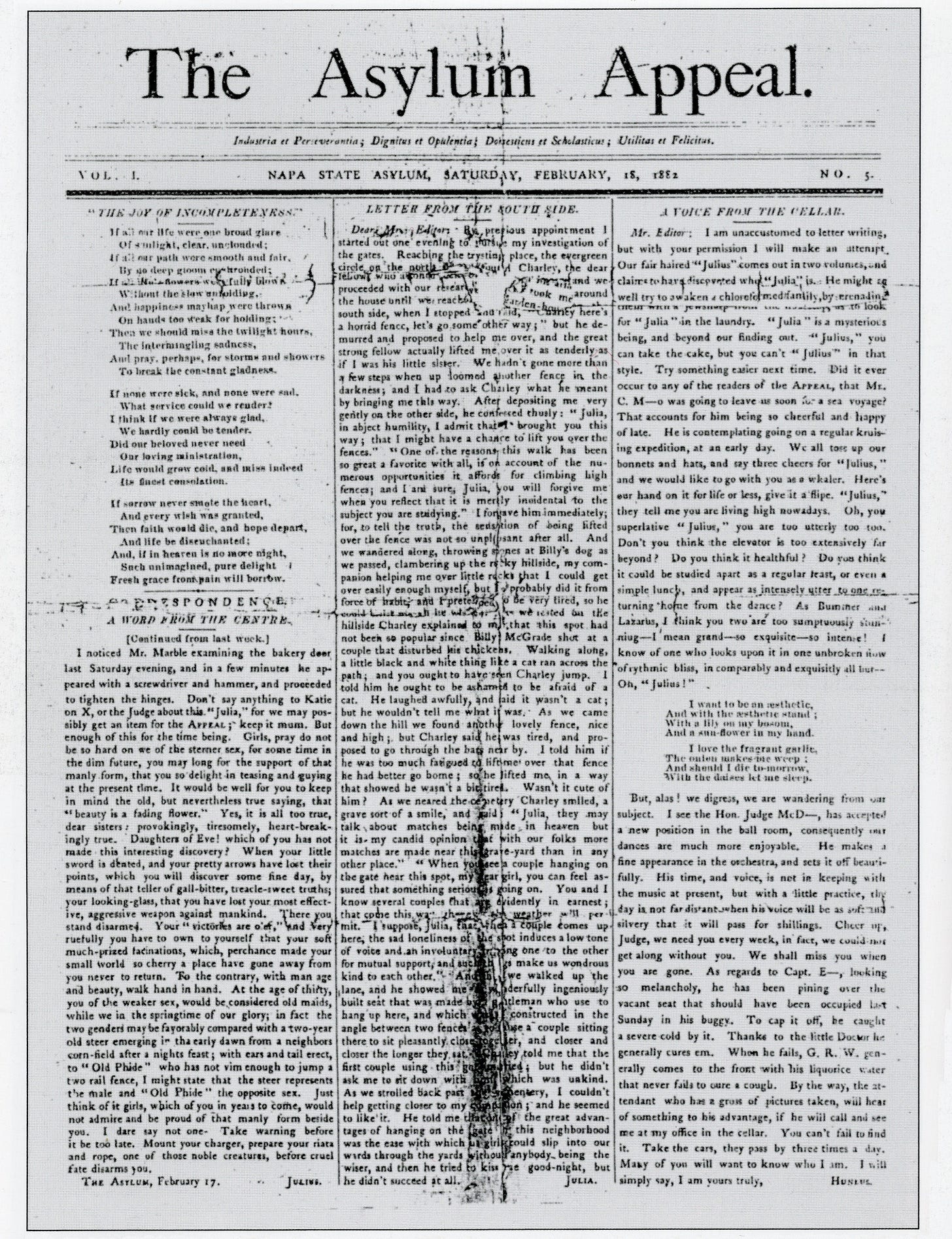
I jealous of this hundred+ year dead lunatic’s career.
Also, here’s that video of The Cramps playing there that one time:
WHITES by Norman Rush
A striking moment from Bruns, the opening story in Rush’s Whites. Two men prepare to engage in fisticuffs on the dusty streets of Keteng when suddenly the huffing and puffing aggressor inhales a fly, bringing it quite far up his nostril. Flies in the area are known to spelunk the nostrils of wildebeests, lay eggs, eggs that hatch into maggots, maggots that eat the wildebeest’s brain. When this happens the wildebeest is left with absolutely no choice but to gallop in circles until it dies of exhaustion. The fight does not occur.
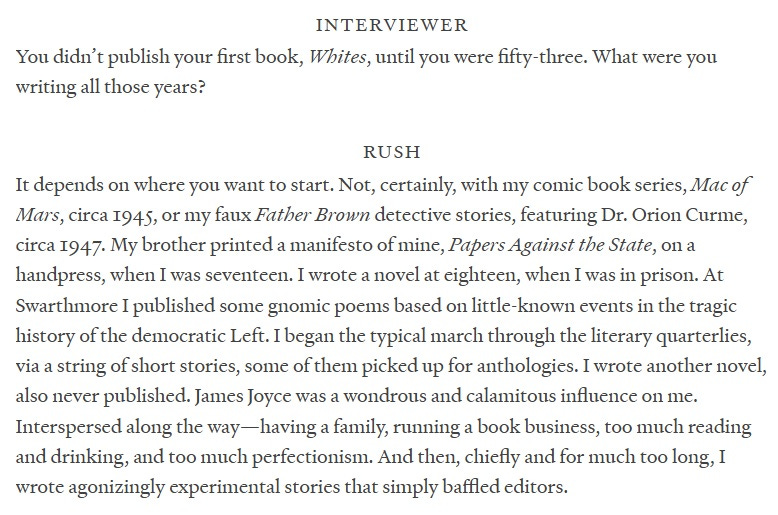
I read Norman Rush’s acclaimed novel Mating some years ago, on which I can only echo said accolades. It’s a beautifully written, excruciatingly brilliant tome, that is like all the best books, about everything. I didn’t find Whites to be doing quite the same plumbing that Mating did, but regardless it is still a delight. I was thrilled to trip across a used copy to own over at Pelican Bay Books some time back while passing through Anacortes, WA. I really ought to get my hands on his later book, Mortals, as well. Tangentially related to why I love Norman Rush, below is an excerpt from an old Paris Review interview of his that gives me hope for the chaos of my personal work ethic and the bumbling of my psyche. I’d love to get my eyes on those old gnomic poems he mentions. I bet they are ridiculous.
GRENDEL GRENDEL GRENDEL dir. Alexander Stitt
I work with a couple of teenage boys who wash the dishes in a room adjacent to where I cook the food. They don’t do the best job but they’re good kids. Smarmy little misfits who I think I can relate to being something like twenty-five odd years back. Since the kitchen I cook in is storied with accolades and prestige, dinner service regularly gets busy enough to keep us in bondage far too late into the night. We are in a pretty rural place and none of us live properly within the town of about seven total streets where the restaurant is located. Additionally, neither of these kids seem to have folks who can be all that bothered to pick them up at eleven p.m. on a school night. Thus I often find myself giving one or both a ride home once the last wine glass is polished and hung. These drives, with the seemingly bottomless energy of seventeen year old boys riding shotgun, have become a highlight of my work week. Apart from being kind of hilarious, they’re both at an age where some childhood interests in fantasy and mythology are beginning to bleed into more “young adult” interests in philosophy and art. The conversations are good. So in an effort to foster this development I try, casually, to make recommendations without being too “grown-up mentor” about the whole affair. My biggest success in this arena has been getting them both to read John Gardner’s 1971 masterpiece, Grendel. I had to track down a couple of used copies of the book and pass them along to make it happen, but I was impressed that once I did they followed through with actually absorbing it. An interesting side-effect however is that in the follow-up conversations about the book, they ended up inspiring me to reread it myself, so that I could latch on to the bits and bobs of the narrative they’d plucked to discuss, those having faded some decades back into the miasma of my reading memory. I then subsequently went down a bit of a Grendel/Beowulf rabbit hole. Due to this I uncovered Alexander Stitt’s early 80s animated interpretation of the novel titled Grendel Grendel Grendel, a film I ended up enjoying quite a bit. While the movie has a a few musical numbers that I didn’t exactly love, Stitt has retrofitted Gardner’s story with an intriguingly bright visual aesthetic, as well as a wry sense of humor. Neither of these elements are implied by the source material in any way, but I found they still jived well with its themes of Sartrean quandary. This, in a way, I feel is in the spirit of what Gardner did to the original Old English epic in the first place. I wish more book-to-film adaptations took the risks this movie did. You don’t come across them often enough. I found this on Tubi, by the way. Maybe you can too.
Honorable mention; I also got those two dishwasher punks into Necronomitron.THE BOOK OF THE NEW SUN by Gene Wolfe
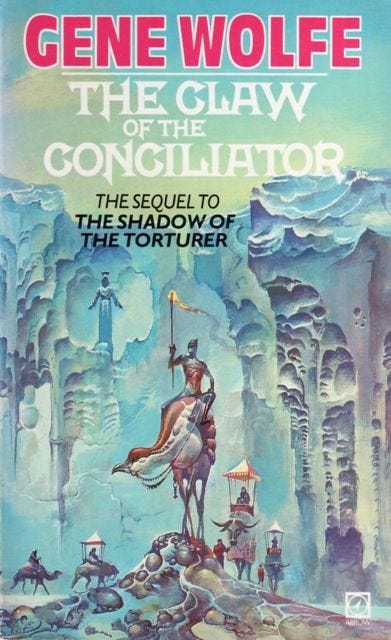
I am not much of a genre fiction reader2. As a kid I was as into sci-fi and fantasy as a kid is supposed to be probably, but at some point my interests drifted toward the loathsomely termed “literary novel.” Working in the book peddling business for many years, followed by the “small press” or “indie” book publishing business for a number more, this unfortunate affliction of mine was only agitated further. It has taken until just this decade for me to spur myself away from the cowed herd of snobby literature consumers (opinions!!) and to unconcern myself as to whether or not my reading list is important to some obscene zeitgeist ripe to be made passé by garnering, I don’t know, LitHub attention or something (LitHub is fine). The perceived difficulty I do have with genre fiction now though is largely style based. Science fiction, to me, seems to spend a great deal of time selling the reader on the machinations of its respective world. Adrian Tchaikovsky’s Children of Time and Liu Cixin’s The Three Body Problem are both great examples of this. Spider societies and alien doomsday invasions should be super interesting, but despite high recommendations from people I trust, I was uncomfortably bored trying to make it through both series. I just couldn’t shake the feeling that I was being explained to (Cixin’s book in particular contains multiple “explainer” chapters) in a way that felt like I was completing a syllabus I had never enrolled in. I won’t call this bad per se. I like the thought experiments, but the format is for someone else. Fantasy on the other hand—and I am largely talking sword & sorcery here; I’m aware the term is an amalgamate of infinitesimal subgenres—in my limited experience, seems less concerned with this sale. And while I do like that tendency of fantastical novels to cast the reader onto a landscape with no compass, I am daunted by the idea of sifting through all the Tolkien clones Tor Books has to offer to find the good ones. To boot, much of the fantasy enthusiast community seems to have little issue discriminating, as long as the requisite cantrips—swords, goblins, what have you—show up. So yeah, it took me a really fucking long time to believe anyone that Gene Wolfe wrote the absolute masterpiece he did when composing The Book of the New Sun. I would like to elaborate extensively on why I believe this, but I went in mostly blind and I think that’s best for any potential initiate to the series. Hence my writing here being more or less about what the book isn’t. The internet is rife with reviews, interpretations, and spoilers if you want though. I’ll only say that I found it to have more in common with with the work of Alain Robbe-Grillet or Nathalie Sarraute than any of the aforementioned genre trappings. Incredible stuff.
PISTACHIO WARS dir. Yasha Levine & Rowan Wernham
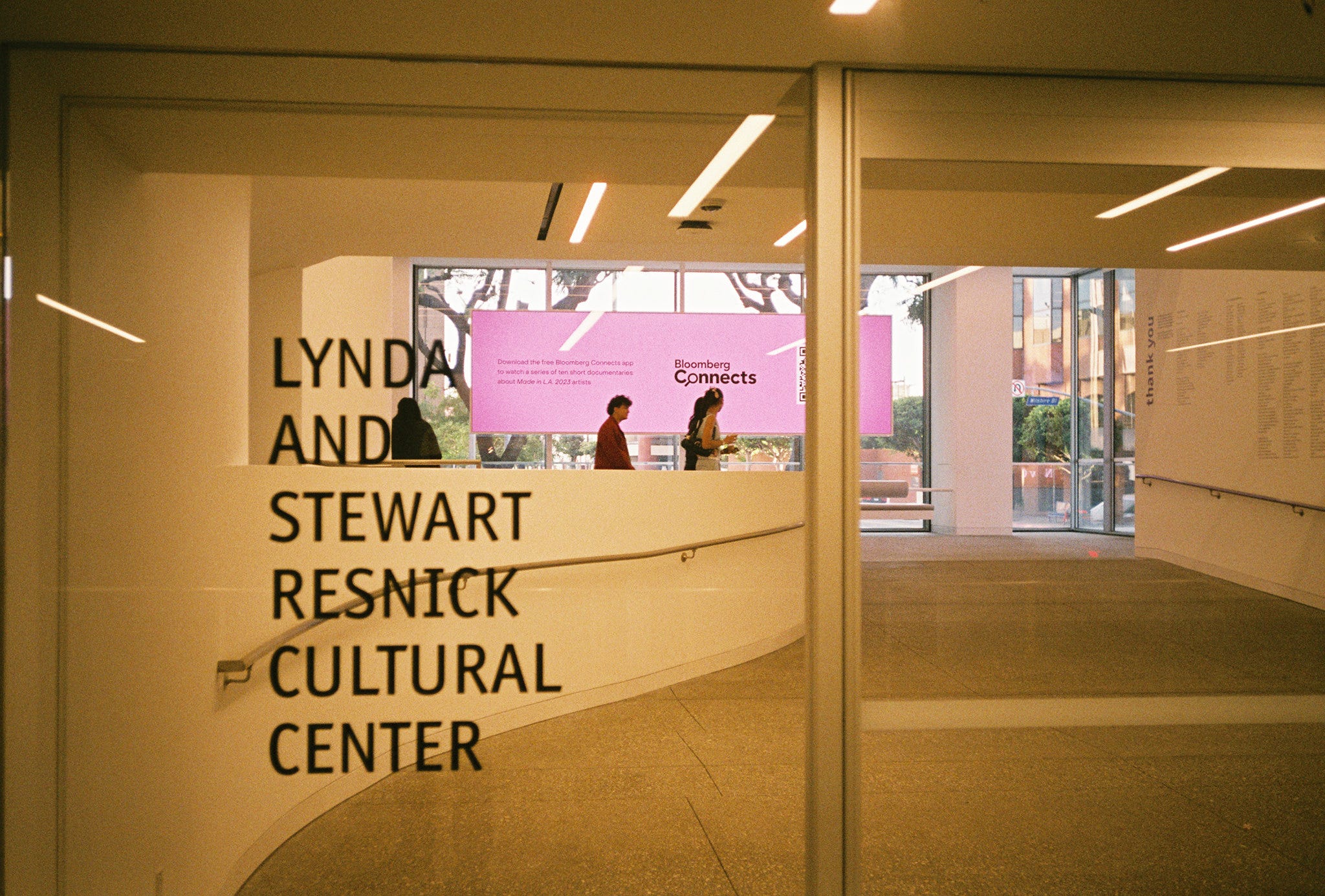
Being both a native Californian and having spent (too) much time in “the art world,” I became well familiarized with the legacy of the Resnicks. Their money comes from the water, with which they operate a farming empire. They are massive political donors and serial artwashers, whose names appear in ubiquity in the latter sphere for those with eyes or offshore accounts to see. Simultaneously less and more visible however is their outsized impact on the landscape of my beloved home state. Concrete aqueducts crosshatching the San Joaquin Delta that my high school friends and I once descended our cars into. Chemical stink rising through pistachio and almond groves along bored, greybrown stretches of the lower I-5. Aluminum siding, encrusted with saline, relaxing a million years to rust off every frontage road gully. Toiling immigrants. My father poxed with cancers after a quarter life as an agricultural inspector. The enormity of these attractions—from the physical: like cement, to the psychic: like familial death—are Babylonian in proportion. As attempting to perceive all land. All life. Undeniably there, but all too factual to calculate. Simpler to spy the Golden Gate in the foreground. HOLLYWOODLAND. Redwoods and yucca palms. I love that Yasha and Rowan made this documentary. It is a valiant attempt to identify just one piece that makes California, with its outsized global impact, the unsolvable puzzle it is. The Resnicks seem to have hidden in plain sight for so long, its strange to think that it was not conceived much sooner. My only minor critique is that they did not go further, elaborate on the water commodity infrastructure and its place in global conversation3. I have a lot of questions and a handful of leads sprouting from my own personal research on them, so I was mildly disappointed when I felt the film came to a close in a way that made me feel more like the filmmakers had run out of gas rather than road. Still, it is excellent work. And the point is made: In California the Resnicks lay foundation for a charnel house to rest on top of the world, and it seems no one with any sort of power is at all interested in stopping them. Likely not the safest topic to probe anyhow. What is to be done? As it goes in my favorite Gun Outfit song, The 101, Carrie sings its final lyric, “At the edge of the world, you look down at your feet.”
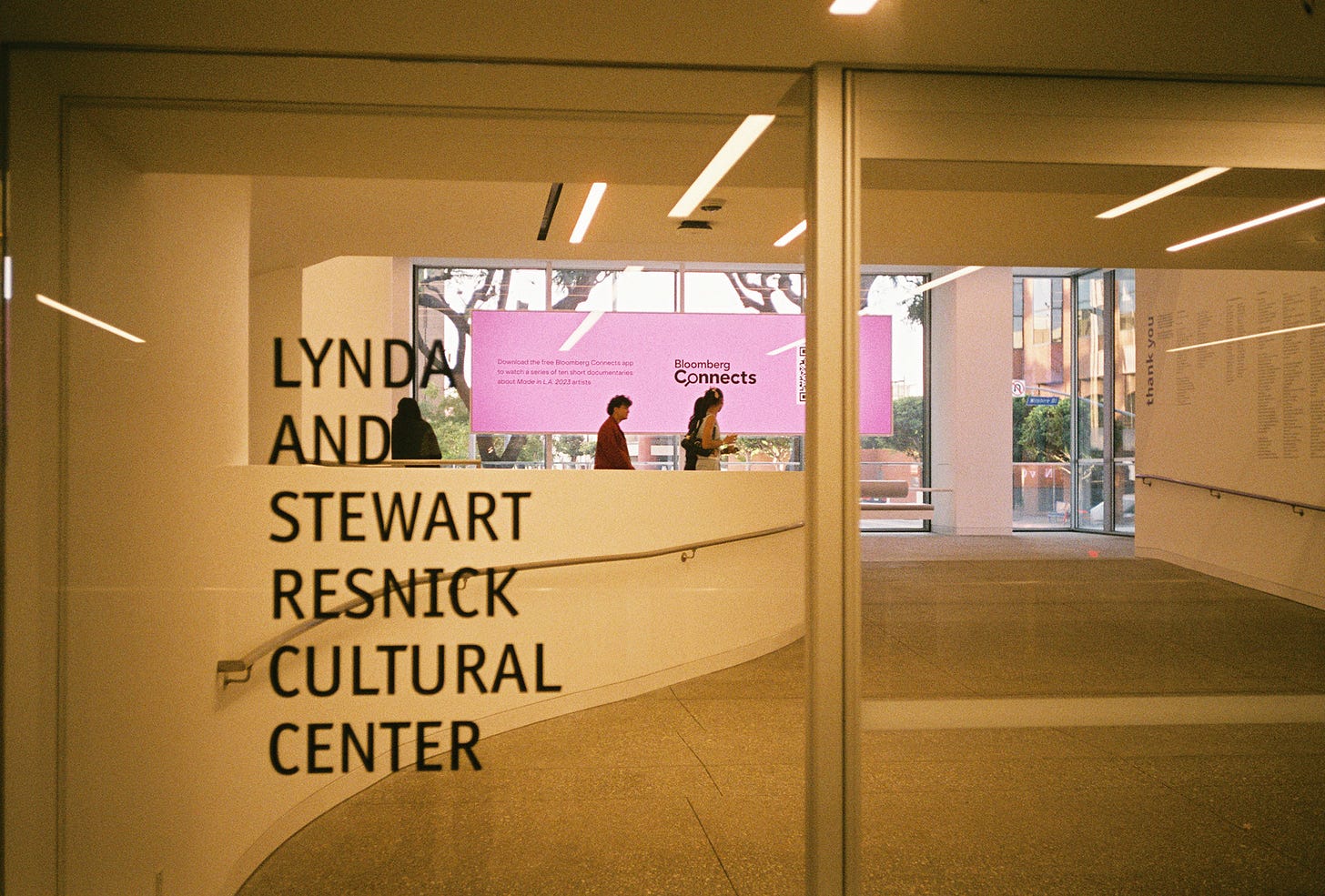
The Hammer Museum. Photo by me, 2023.
JIM O’ROURKE - Live in Japan 2002.9.16
O’Rourke’s music has been with me since my late teens. The man is responsible for a sonic monolith implanted into my brain, shaping my movements and speech forever after. This is something I cannot possibly illustrate in words here, for music is holy and blogging è purgatorio. That’s why Pitchfork Media is so embarrassing to read. But that’s neither here nor there. Suffice to say, regarding Jim, I am a huge fan. The high of my first blush with his music is something I am always chasing. Earlier this year I got to experience a note of that felicity when I discovered a well recorded live performance of the man, in Japan, more than twenty years ago. Again, I cannot speak on these sounds. Lay on the floor and forget that you woke up in the same body today as you did yesterday. What a show this must have been to present for. He closes with an unbelievable Tracy Chapman cover; imprinting an already perfect song even deeper into my psyche.
VISIONS DE L’AMEN - Olivier Messiaen
The third nearest town to me has a small antique store, which features a basement level cache of used vinyl. Someone in there knows what they’re doing, most notably to me in its small classical section, which always seems to be richly seeded with the avant garde. I’m not a religious man, but the grandiosity of religious fervor fascinates me, as does much of the art made in its grips. Because of, this recording of Olivier Messiaen’s Visions de l’Amen caught my eye first for its cover, so I was quite happy to take it home and discover strange and arresting compositions, imbued with theoretical treatise and birdsong interpretation. Of course the man’s work is profoundly famous it turns out, but I’m a dunce when it comes to the genre. As artsy music goes I heard The Boredoms4 first, so I’m only now working backwards. In any case, it was a treat to discover him this way. Additionally, I mean to do a small piece on the art and copy of classical vinyl when I have the mind to. The records at this place are cheap enough for me to afford taking chances regularly, and while they don’t often rattle me like Visions de l’Amen, I could come up with quite a lot to share about them as objects.
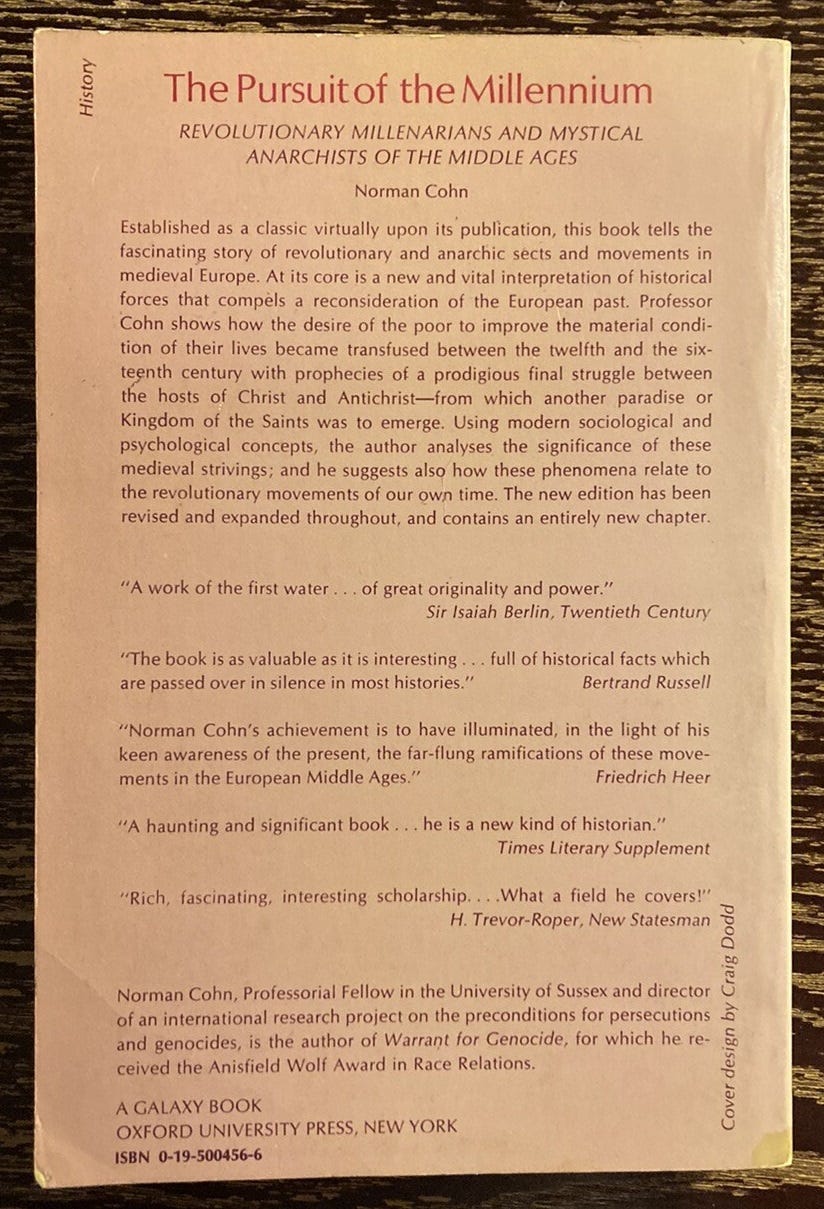
THE PURSUIT OF THE MILLENNIUM by Norman Cohn
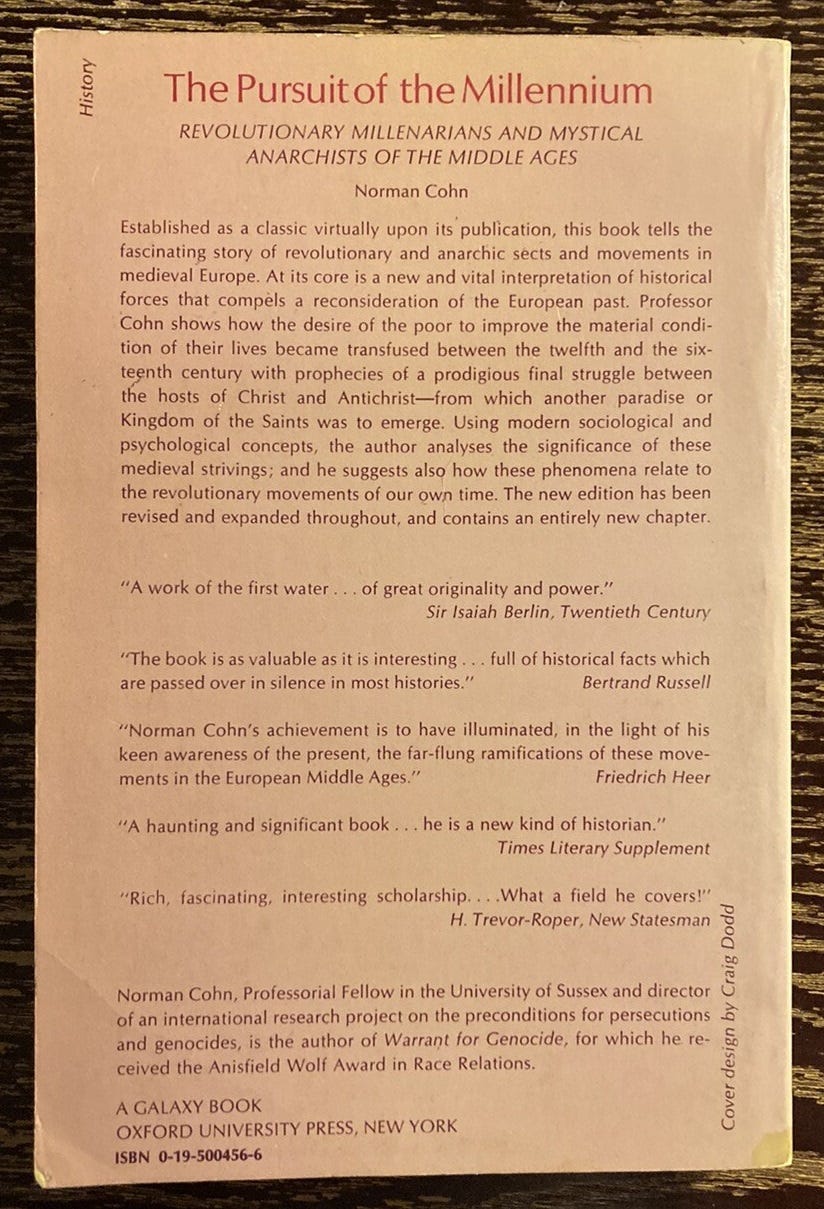
This is not my copy of the book. I found this image online so that I wouldn’t have to describe the thing myself, and an adequate job is done here, at least as far as basic context goes. Much better than my edition, which bear quotes like, “Extremely interesting and well written.” and “It is full of historical facts which deserve to be widely known…” Not the hardest of sells! Let me take it further in the name of justice: Cohn’s one-of-a-kind tome of yore is dense with militant anarchists, papal insurgencies, gibbering lunatics in hermitage, bands of zealots somersaulting nude across piazzas, eventually hacked to bits by Pontifical Swiss Guard, and countless blithering panegyrics to the glory of God and his wrath against all the piggish and unclean. Locusts and gnats. Rocks burst open, bleeding with milk. Beasts which lay with man. Rain of blood. Truly one of the best works of academic nonfiction I have ever encountered. Unimpeachable. And frankly when you read it, you’ll realize little has changed over time but tech.
“So it came about that multitudes of people acted out with fierce energy a shared phantasy which, though delusional, yet brought them such intense emotional relief that they could live only through it, and were perfectly willing both to kill and die for it. This phenomenon was to recur many times, in various parts of western and central Europe, between the twelfth and sixteenth centuries.”
I cannot recommend this book enough.
MARCO PIERRE WHITE
About a year ago I read Bill Buford’s Heat. I’d previously ignored this book. I have a decades held belief that kitchen culture at large deeply sucks, but having recently begun cooking for money in a restaurant of some acclaim, and, having enjoyed Among the Thugs a personality and a half ago, I figured I’d give it a chance. As a time capsule it’s okay I guess. Sadly, I cannot figure out what the fuck happened to Buford’s writing style between Thugs (‘91) and Heat (‘06). The latter is lousy with parentheticals. Useless, inane, sloppy parenthesis infest the book like weevils, maddingly distracting the reader from a fairly worthy amount of good information. When reading it, it is difficult to believe that it’s by the guy who edited Granta back into prestige. But whatever I guess. The chef as celebrity phenomenon had just *truly* exploded when this came out, and Buford got a long look at some outsized characters in the land of culinary drama before cancellation came for a number of them just a few short years later. It is possibly stupid of me to be shocked by this but Chef Marco Pierre White, renowned total asshole and most famous living chef of all living famous chefs, easily manages to be the most engaging encounter in the narrative. Upon meeting, White spirits the author to blast away at grouse in the English countryside with him. He talks about attempting a twenty-one day curing process and taste testing a rotted bird. Then, while dining, snipes away coldly at every flaw in the meal with such precision that you can place on your palate what the plates should have been more vividly than any sprawling NYT food piece of the last two+ decades. Now, despite my forestated aversion to niche food world’s frothing hostility, I’ve taken to catching up on old videos of the legendary chef. In the first part of the series I posted above he displays the expected off-putting petulance, however this is largely eclipsed by not only skill, but the philosophy he cites in dedication to his craft. You can easily believe that he would be the way he is without the cameras, without the acclaim, without all of it. And I rather like his mantra, “We live in a world of refinement, not invention.” In my opinion, artists these days across a whole spectrum of mediums deeply need to absorb this. Maybe then we could be spared so much of pop art’s embarrassing debacles, haphazard, naval gazing autofiction, and all other stalkers of some holy spiritus mundi. Anyway. I guess the revelation here is that perhaps I held out delving into this chef fandom stuff because I found its imitators so nauseating, not the source material.
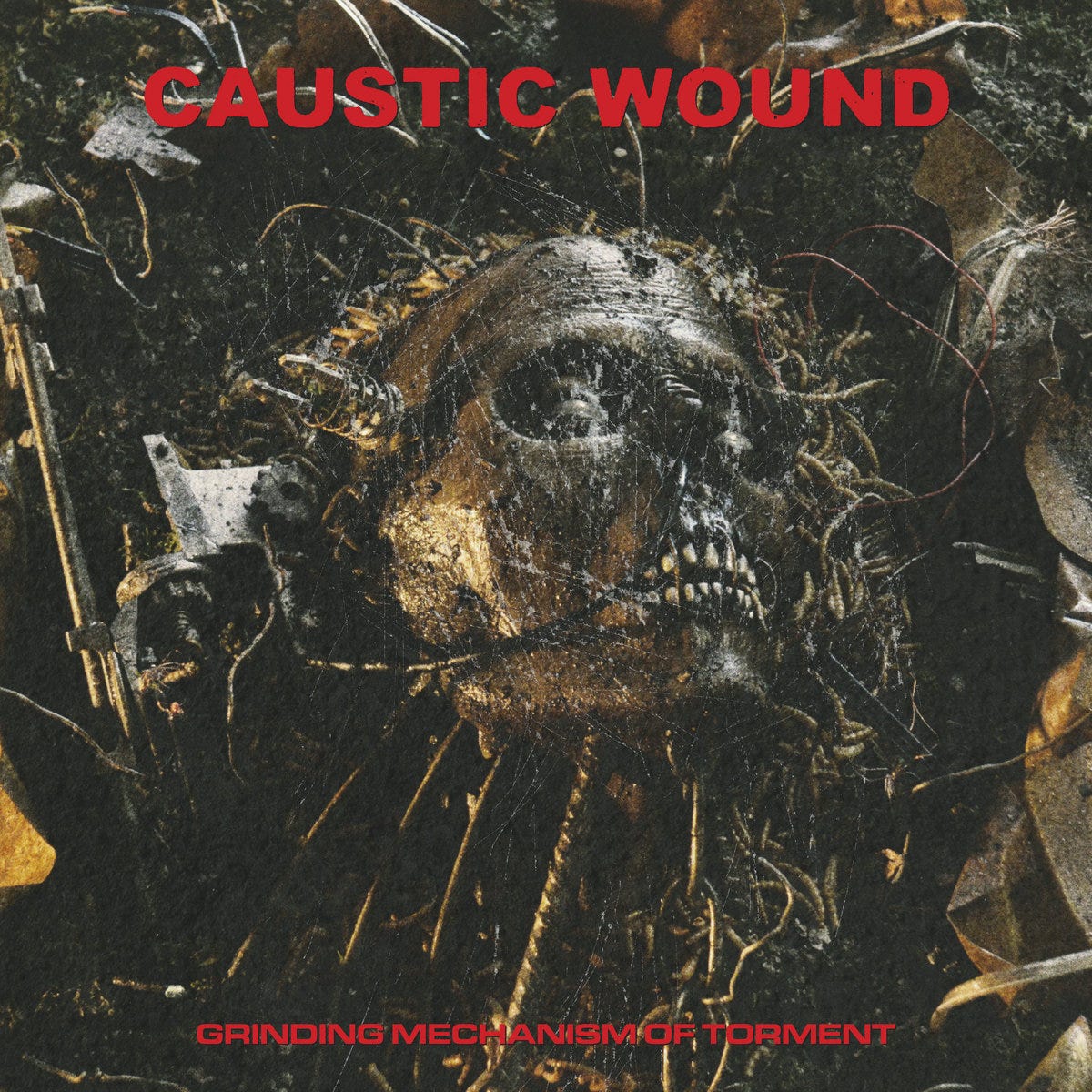
CAUSTIC WOUND - GRINDING MECHANISM OF TORMENT
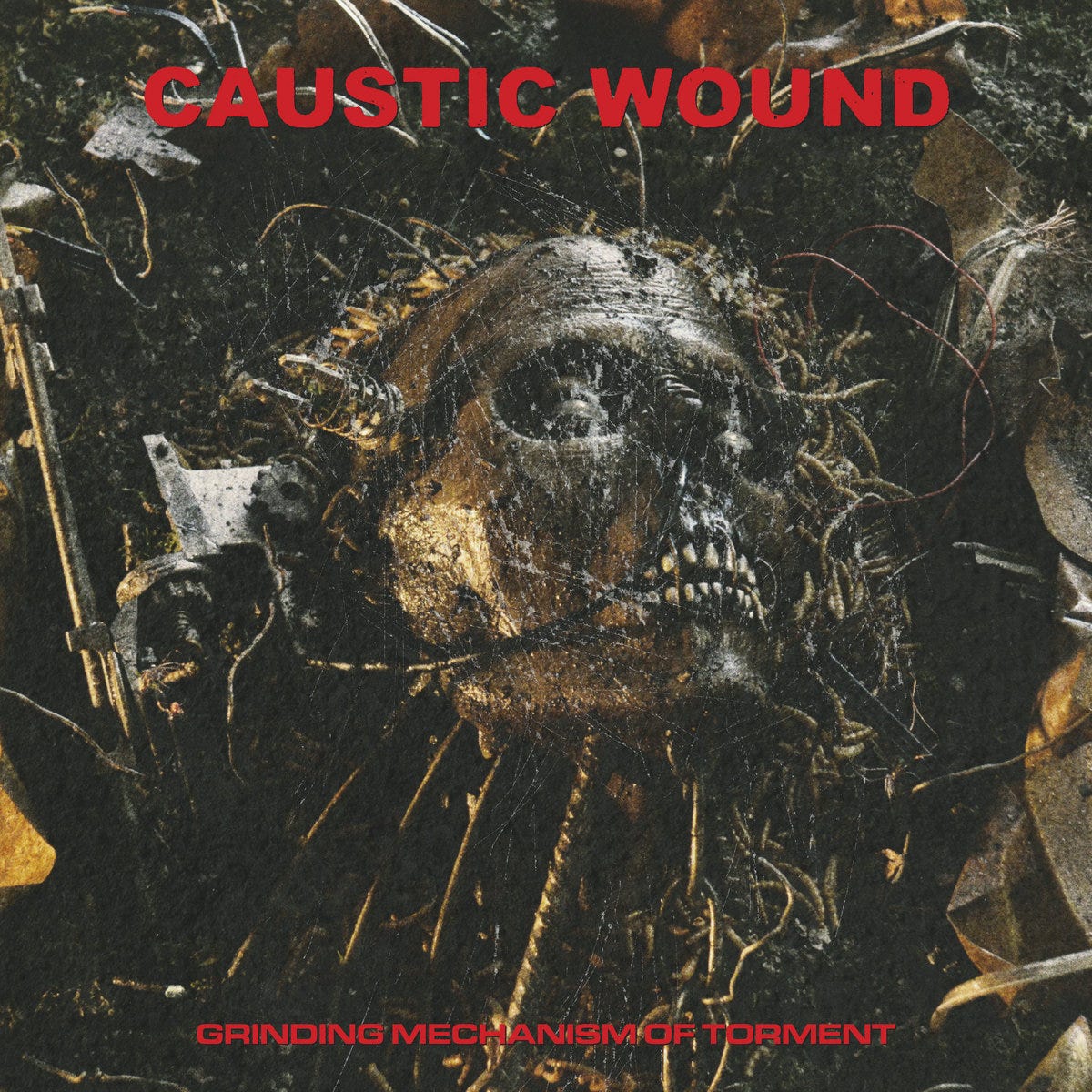
Kyle was in a lot of bands. Kyle made a lot of music. I remember Kyle drunk in the biggest little city, flailing an enormous broadsword he’d bought from some pawn shop, howling for the transgender prostitutes he desperately wanted to love that night. “Where are the ladyboys?!!” he demanded. People were scared. The arresting officers subdued him but he was jailed under a stolen ID he’d been carrying, so it took some time to figure out which precinct he’d been taken to, and longer still to discover that despite soaking himself in piss he’d been released from the tank at dawn and returned to the icy Reno streets, broadsword and all. When found, he’d just shit a runny gallon of metabolized alcohol and sugar into an alleyway, cleaned himself with the brand new Christmas scarf he’d been bragging about the prior evening and then discarded it. “These are the kind of episodes that will break the weak.” and “The next time that happens I’m going to moonwalk in handcuffs.” he authoritatively stated. He spoke as if revisiting the content of a DVD boxed set and not the consequences of his own actions. I also remember Kyle hauling heavy bundles of lumber on his back down rutty West Oakland sidewalks. Huge rolls of insulating foam. He was helping Andrew build his first recording studio, not asking a cent for his labor, only doing it because immediate life would be more interesting if the studio was built. I last saw Andrew at a show in Los Angeles. He has parlayed his recording experience further, built a new studio, and garnered even more success than he had with his early endeavors in The Bay. Smoking cigarettes behind the venue, we mostly spoke of Kyle that night, whose wild life has extended well beyond the pace our age will allow any longer, but we both miss him. Kyle had a mysterious flickering presence, burning bright and hot for as long as you’d welcome it, until poof. Then, we listened to grindcore a lot more than we do nowadays, though it remains a fundamental building block of our shared cultural experience, and Kyle is inseparable from that time. So Andrew recorded the new Caustic Wound album. It’s extremely good both compositionally and sonically, if you’re into this sort of thing. Kyle has nothing to do with it of course. I’m making a connection that holds little sense for anyone, unless you were there all those years ago. It’s just so funny that this sort of music makes me wistful now.
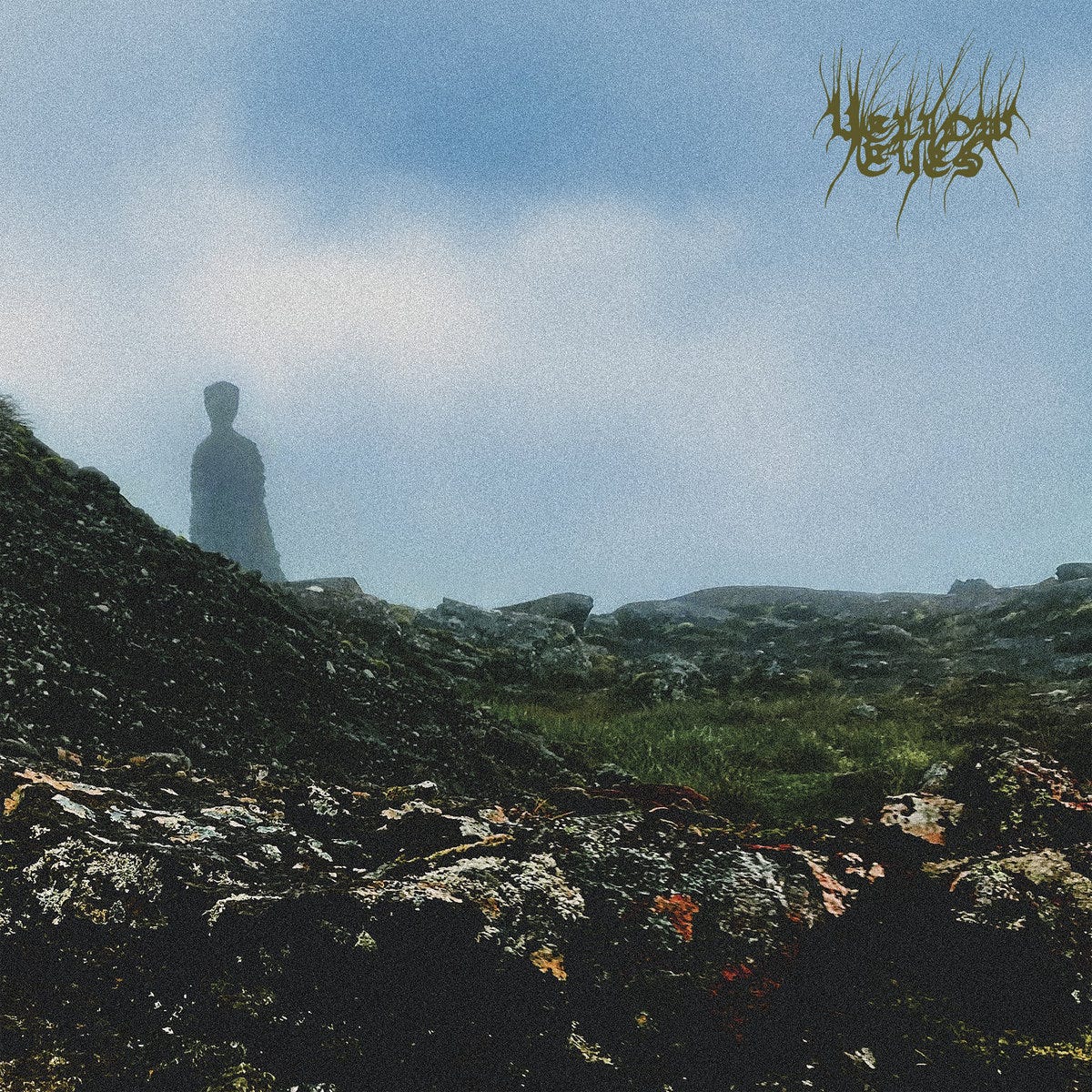
Their last album, Master’s Murmur, didn’t do it for me, even though the title is hilarious. The weird ambience of it was cool, but mostly I felt it drifted too deeply into that misty JRR Tolkien territory that black metal has a tendency toward. I just can’t get down. Confusion Gate is a welcome return to form with just the good bits about MM retained, and is my favorite since their debut, Silence Threads the Evening’s Cloth. My favorite track on this one is Suspension Moon, but my favorite track title is the opener, Brush the Frozen Horse. I’m currently in the middle of Andrey Platonov’s fun filled novel, The Foundation Pit, a triumph of depressive Soviet absurdism, and those words feel as they could be lifted straight from the book. Great timing. An excerpt:
“Evening was already setting in; blue night was rising in the distance, promising sleep and cool breathing; and above the earth, like sorrow, stood the dead height. As before, Kozlov was annihilating stone in the earth, not turning his eyes away from anything, and his weakened heart was probably beating boringly.”
PETER IVERS
If you’re here, reading this, you probably know about Peter Ivers, even if you don’t know you know about Peter Ivers. You know the Lady in the Radiator song from Eraserhead. That was his song. The Pixies covered it, remember? If you still don’t know Peter Ivers then you can read this Guardian piece from 2019, written to compliment a reissue of a bunch of his stuff when it came out. And if that’s too long (I don’t believe you, you’re already halfway through this painfully meandering blog post), I suppose all you need to know is that he was the undercurrent beneath just about everything cool in his time, and that he was brutally murdered with a hammer at age thirty-six. A case that remains unsolved. I’m on my fifth or five hundredth dive into Peter’s life’s work, as in love with it as ever, and happily finding more and more clips of him on Night Flight’s New Wave Theater uploaded around the web, tempting me to shell out for those old Rhino Records VHS compilations once I don’t need so many pennies for wishing anymore. RIP freak hero.
CLAUDE VIVIER
Speaking of artists who were brutally murdered in their prime. CBC Radio’s About Time program hit me with Claude Vivier on a gloomy drive into town the other week. I had been previously unfamiliar with Vivier’s compositions but the striking excerpt I caught on my drive inspired me to seek out his work and now I am immersed! Oscillating between desperate chaos to venomously moody evocations, it’s been perfect soundtrack for crashing into the cold season where I currently am. I’m also thrilled to have so serendipitously found him and the wealth of interpretations of his work so close to having stumbled across Messiaen’s. The former feels very much in lineage with the latter. Additionally, I like how Vivier’s biographers all feel the need to mention that he was a little gross. From his wiki page:
“Especially as his career was beginning, Vivier was recalled by many to have had incredibly poor hygiene. He was noted for wearing the same shearling coat nearly every day of his adult life, and growing out his greasy, long and unkempt hair. One acquaintance recalled how horrible and sheep-like he smelled, much to the bother of his classmates and teachers, including Stockhausen.”
ALL NIGHT MENU Vol. 5 by Sam Sweet

The greatest zine on LA currently in print came out with its fifth issue earlier this month. A minor working relationship with author Sam Sweet allowed me to get my copy a little early, but I read it only recently, after hearing from my ex who went to the release party for it and got in touch to tell me how great the event was. The pang of homesickness I felt for California was immense. The thesis behind Sam’s project is to document the bold LA histories beginning with a simple common factoid: their addresses. As always, the most recent installment contains a gripping assortment of purely Californian tales. Artistry, insanity, violence and wonder are on full display as it lily pads from the addresses of Marjorie Cameron to the final performance space to host Chalino Sánchez5 and more. Locales endlessly around the globe deserve a such gloriously devoted and lovingly crafted tributes, but in the absence of so many for the time being, I encourage everyone to go support Sam in his project. This is essential work in the self-publishing world.
The above photo is by me and has nothing to do with the All Night Menu series. I just felt it appropriate, as it is depicts a famous address I passed nearly every day for close to a decade.
CHESS<dot>COM



In the introduction to Franco ‘Bifo’ Berardi’s book Quit Everything (which I previously recommended in an earlier post here), he opens with a passage on the Russian invasion of Ukraine:
“When the war broke out, I felt unable to take a position in favor of one or the other of the two contenders, because the reasoning of both implied destructive and unacceptable projects. The rhetoric of liberal democracy represented the interests of Western financial capitalism, while the rhetoric of the Russian national sovereignty represented the interests of a brutal oligarchic class.”
On chess dot com I recently spent a month playing a number of fairly evenly matched games with a contender in a region I did not recognize. Finally acting on my curiosity regarding their whereabouts, I tapped their flag icon and was greeted with the above article (excerpted). My reserved opinions about the chaos occurring in Eastern Europe essentially mirror Berardi’s, making it tough to sincerely get all “Slava Ukraini,” as it were. A head scratcher as the saddest state of affairs. Chess dot com seems to have no issue taking a position however. Not depicted here is their in-app emoji selection, in which the dove of peace is colored as the Ukrainian flag is. Something I didn’t notice until a bit later. I mostly note this all as points of interest in the strange history of being constantly reminded that we cannot seem to stop blowing each other to bits. More importantly though, I’m super into the game of late, but I’ve only got one friend nearby who will play me in person. Add me on the app and let’s get into it. My handle is mister_strategy.
AFRICAN MYTHS OF ORIGIN
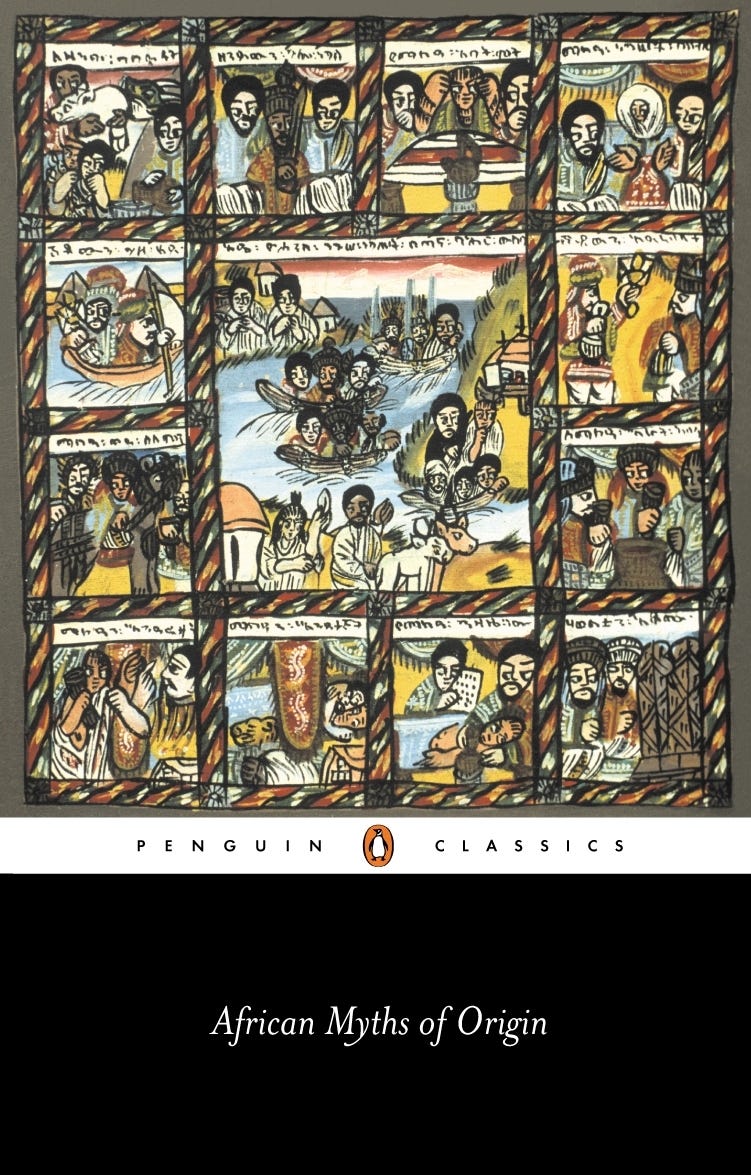
Not much of a review here. I picked this book up to pass some time after being stuck to wait on a delayed ferry from one island to the next. I chose it due to a weak selection within my price range at the nearest bookstore, and for my unfamiliarity with its subject matter. It lives in my truck now and is my official “waiting book” until I feel the need to move on. So far so good though. Here’ a fun passage to close out this list:
DEATH
The creator watched the humans and decided they should live for ever [sic]. He summoned the chameleon and told him to carry the message to the humans that they would not die. Then he watched as the humans multiplied, and decided that perhaps it would be better for them to die after all. So he summoned a lizard, and told him to carry the message to the humans that they would die.
The chameleon moves very slowly and deliberately. The lizard skitters along at great speed. The lizard arrived long before the chameleon and told the humans what the creator had decided for them. When the chameleon arrived worth his more pleasant message, it was too late.
Okay, actually you know what? One other gripe. Discordia, your ‘about’ page is deeply in need of an update. Maybe the overworked rant was the torch that lit the pyre, but you’re rolling along swimmingly now. At this point all the stuff about douchebags and pissing and crucifixes is like… C’mon. That horse is already dead, y’know? Send that stuff to the cornfield. I am displeased. That first sentence could end at “literary scene,” and the the rest up until “We also publish zines in print” could disappear and nobody would miss it.
I am well aware that this entry on the list follows my citation of Grendel, ostensibly genre fiction. Give me a break.
For the record, they do get there, but it feels like more of a footnote toward the end. I wanted more. I get it though, documentaries are time consuming, expensive, and in the context of ones that probe the nodes of global power as this one does, probably dangerous.
Regarding the link here: I’ve owned a first pressing of this LP since the summer after high school. It’s one of the few personal items I’ve managed to hang on to through multiple cross country moves, countless apartments, shameful pawning sprees, and even a sketchy storage situation when I stashed a bunch of my stuff beneath a shotgun house in New Orleans for a summer because it was cool down there and couldn’t be seen from the street. I can still hardly believe this record has survived it all. An enormously prized possession of my life.
In the opening to the video in the link here he is reading a note explaining to him that he will be killed after the performance, which he was. Bound by the wrists with two shots to the back of the head.